Where Household Batteries Go in Singapore's Waste System
Why household batteries cause fires in Singapore's waste system and the correct disposal pathway through ALBA E-waste collection points under the Producer Responsibility Scheme.
Where Household Batteries Go in Singapore's Waste System
The single most dangerous item you can put in a general waste bin or a blue recycling bin in Singapore is a household battery. A lithium-ion rechargeable battery, especially. The correct route is an ALBA E-waste Smart Recycling bin. Not the chute. Not the blue bin. Put a battery in the wrong bin and it is likely to start a fire in a collection vehicle or at a materials recovery facility before it ever reaches an incinerator.
Here is the short version of what happens and why it matters. A lithium-ion battery that gets crushed in a collection truck goes into thermal runaway, igniting the surrounding load. Singapore's waste collection vehicles and its sorting plants at Sarimbun Recycling Park have recorded fires caused by discarded power cells, a problem the National Environment Agency and ALBA have publicly warned about since the Producer Responsibility Scheme for e-waste started in July 2021.
The correct destination for a household unit, AA, AAA, 9V, button cell, rechargeable lithium-ion, power bank, is one of more than 800 ALBA drop-off points across the island. From there the items are sorted by chemistry, shredded under an inert atmosphere, and exported to South Korea, France or Belgium for material recovery. Cobalt, nickel, lithium, manganese and steel are recovered. What does not go to ALBA goes to an incinerator and then to Semakau Landfill. That route is where the fires happen.
Why Batteries Cause Fires in Singapore's Waste Stream
How a Single Cell Ignites a Collection Truck
The mechanism is not mysterious, but it is poorly understood by most householders. A lithium-ion cell contains a flammable organic electrolyte and a separator that, once damaged, allows the anode and cathode to short-circuit. The short generates heat faster than the cell can dissipate it, a process called thermal runaway. In a collection vehicle, the unit is crushed, punctured, or mixed with conductive metal items such as aluminium foil or steel cans. The result is a fire inside the truck before it reaches the incineration plant.
At a materials recovery facility, the same thing happens on the sorting line. Cells that slip through the manual pre-sort end up in the shredder or the trommel, where mechanical impact triggers ignition. MRF operators at Sarimbun Recycling Park have reported fires from power sources hidden in commingled recycling. The fire risk is highest for lithium-ion types, but alkaline units can also leak corrosive potassium hydroxide and damage equipment.
What the NEA Requires You to Do
The NEA has repeatedly issued an advisory: tape the terminals of any cell before depositing it, and never put these items in the general waste or blue recycling bins. The advisory has been reiterated every year since 2021. The fire risk is the reason the Producer Responsibility Scheme exists. The Resource Sustainability Act 2019 was designed, in part, to get these items out of the thermal waste system.
ALBA E-Waste Battery Collection: How It Works and What It Covers
The Producer Responsibility Scheme for e-waste, operated by ALBA E-waste Smart Recycling, is the only legal and safe route for household portable power packs in Singapore. The scheme began on 1 July 2021 under Part 3, Division 2 of the Resource Sustainability Act. ALBA was appointed for a five-year contract term from 2021 to 2026.
What You Can and Cannot Drop Off
The scheme covers any sealed portable unit weighing up to 5 kg that is not for industrial use. That includes AA, AAA, AAAA, C, D and 9V types, button cells, rechargeable lithium-ion and nickel-metal hydride packs, nickel-cadmium units, and power banks. Excluded are lead-acid car batteries, industrial packs over 5 kg, and cells embedded in non-e-waste products. Those have a different regulatory route: they are Toxic Industrial Waste under the Environmental Public Health (Toxic Industrial Waste) Regulations.
Step by Step: Drop-Off to Material Recovery
To dispose of a household unit, bring it to any ALBA collection point. The network exceeded 800 locations in 2023. Drop-off points are placed at retailers including supermarkets and electronics stores, community centres, schools, government buildings, and dedicated e-waste bins. Tape the terminals before you drop the item in, as the NEA advisory instructs. ALBA collects the loads, sorts them manually by chemistry, and sends them to a shredding facility. The shredding happens under an inert atmosphere to prevent combustion. Ferrous metals, non-ferrous metals, plastics and black mass are separated. The black mass contains cobalt, nickel, lithium and manganese, which are recovered by specialist processors in South Korea, France and Belgium.
There is no domestic reprocessing plant in Singapore as of 2026. Every unit collected under the PRS is exported. The Resource Sustainability Act prohibits incineration or landfilling of regulated e-waste collected under the scheme, so the exported tonnage is the only acceptable outcome.
Collection Volumes and Targets Under the EPR
The collection targets for portable packs are set as a percentage of supply, rising from 14% in 2021 to 42% by 2028. Actual collections have grown quickly: 14 tonnes in 2021, 79 tonnes in 2022, and 153 tonnes in 2023, according to the NEA Waste Statistics and Overall Recycling Rate 2023. The supply to the Singapore market in those years was approximately 1,200 tonnes in 2021, 1,300 tonnes in 2022 and 1,400 tonnes in 2023. That means the collection rate, the percentage of units sold that are returned, was roughly 1% in 2021, 6% in 2022, and 11% in 2023. The gap between collection targets and actual returns is large. The missing units are going into general waste and recycling bins, where they cause fires.
Lithium-Ion Battery Recycling Singapore: Where the Process Breaks Down
The reprocessing route for lithium-ion packs in Singapore is entirely outbound. No domestic facility exists, so every unit collected under the PRS must be packed, containerised and shipped to a recycler overseas. That dependency on overseas markets introduces a logistical cost that makes the economics of collection marginal. The scheme is funded by producers, the companies that supply portable units to the Singapore market, under the Producer Responsibility Scheme, but the cost per tonne is high relative to the value of the recovered black mass.
The recovery rates for cobalt, nickel and lithium are high at the overseas shredding plants, but the energy and carbon cost of shipping loads to South Korea, France or Belgium is not accounted for in Singapore's waste statistics. The net environmental benefit of the current route, compared with incineration with energy recovery, is not published by NEA or ALBA.
The practical problem for the householder is that the ALBA network, while large, is not as omnipresent as the blue bin or the rubbish chute. You must store dead units for up to a week and carry them to a drop-off point. That friction is the main reason power packs end up in the wrong bin. The NEA and ALBA have not closed the convenience gap, and the fire risk persists because of it.
Dispose Batteries Singapore NEA: What the Regulator Says and What It Does Not Say
The NEA's position is clear: household portable units must go to ALBA e-waste collection points. The agency publishes the list of accepted types, the advisory to tape terminals, and the prohibition on incineration or landfilling of regulated e-waste collected under the PRS. The NEA also publishes the annual collection targets and volumes in the waste statistics yearbook.
What the NEA does not publish is a disaggregated figure for power-pack waste generation. The waste statistics do not separate portable cells from the broader e-waste stream. There is no published Singapore-specific estimate of the improper disposal rate. The agency's compliance enforcement for disposal is not visible to the public, and no fines for domestic mis-disposal have been reported. The scheme relies on voluntary participation by householders and on the collection infrastructure provided by ALBA.
The NEA has also not published a comparison of the fire risk from power packs in collection vehicles versus the fire risk from other ignition sources in the waste stream. The agency's annual reports on incineration plant fires do not attribute specific incidents to these items. The fire-risk narrative comes from ALBA and from MRF operators, not from a systematic NEA data release.
The Gap: Non-Regulated Batteries and the Missing Collection Network
Car Batteries and Industrial Packs
The ALBA E-waste Smart Recycling scheme covers only portable units. It does not cover industrial packs over 5 kg, lead-acid car batteries, or cells embedded in non-electronic products. Those fall under the Toxic Industrial Waste regulations, which require a licensed waste collector and a manifest system. For a household, the only common non-regulated item is a car battery. Car batteries are lead-acid, heavy, and contain sulphuric acid. They must not go to an ALBA bin. The correct route is to return a car battery to the automotive workshop that replaces it, or to a licensed scrap metal dealer. Most workshops accept the old unit as part of the replacement service; if they do not, the NEA's list of licensed Toxic Industrial Waste collectors is the reference.
What Small Businesses Need to Know
For small businesses, the gap is wider. A small F&B or retail operator that accumulates rechargeable packs from equipment has no free collection network equivalent to the household ALBA bins. The PRS is designed for household-generated e-waste. Commercial waste must be managed through a licensed waste contractor, and the cost can be several hundred dollars per collection.
What To Do Next: The One Action That Reduces Fire Risk Immediately
The single thing that most often goes wrong with household disposal in Singapore is that you put the spent unit in the general waste bin because it is the nearest receptacle. The ALBA bin is not at arm's reach, so the item goes into the chute. That decision, choosing convenience over the correct route, causes a fire in a collection vehicle or at a materials recovery facility at Sarimbun Recycling Park several times a year.
Designate a container in your home. A jar, a box, a drawer. Fill it with dead units. When it is full, take it to the nearest ALBA drop-off point. Tape the terminals before you drop them off. That one habit, repeated by enough households, is the only thing that will reduce the fire risk. The collection infrastructure exists. The missing piece is the household routine.
Also in Waste streams
Common Questions
Can I put a dead AA battery in the blue recycling bin?
No. A battery in a blue recycling bin will likely cause a fire at the materials recovery facility or in the collection vehicle. The blue bin is for commingled recyclables such as paper, plastic, metal and glass. Batteries must go to an ALBA e-waste collection point.
What happens if I put a battery in the general waste chute?
The battery goes to an incineration plant. Before it reaches the plant, it may ignite in the collection truck. If it reaches the incinerator, the lithium or other metals are not recovered, and the battery's materials end up as incineration bottom ash that is barged to Semakau Landfill.
Do I need to tape the terminals of every battery before disposal?
Yes. The NEA advisory says tape the terminals of all batteries, alkaline and rechargeable, before depositing them in an ALBA collection bin. Tape reduces the risk of short-circuiting during transport and sorting.
Where is the nearest ALBA battery collection point?
ALBA had over 800 collection points in 2023. Common locations include FairPrice, Giant, Cold Storage, Best Denki, Courts, community centres, and public libraries. The ALBA E-waste Smart Recycling website has a location map.
What about rechargeable power banks?
A power bank counts as a portable battery under the EPR if it weighs 5 kg or less. Tape the terminals or wrap the unit in tape. Do not put it in the blue bin or general waste. Dispose of it at an ALBA collection point.
Read next
-
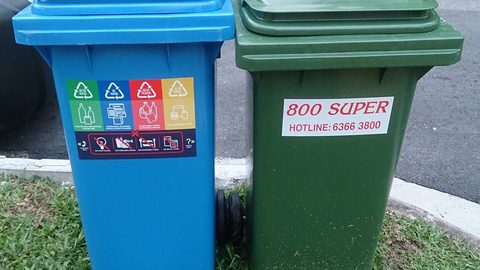 What the Blue Bin Actually Takes and What Happens When It Gets Contaminated
What Singapore's blue bin actually takes—and what happens to a whole truckload when one item is wrong. The contamination rule, not just the list.
What the Blue Bin Actually Takes and What Happens When It Gets Contaminated
What Singapore's blue bin actually takes—and what happens to a whole truckload when one item is wrong. The contamination rule, not just the list.
-
 What Must Never Go in a Singapore Household Bin and Where It Goes Instead
Batteries, lamps, chemicals and sharps must never go in a Singapore household bin. Where each goes instead, scoped to Singapore disposal law.
What Must Never Go in a Singapore Household Bin and Where It Goes Instead
Batteries, lamps, chemicals and sharps must never go in a Singapore household bin. Where each goes instead, scoped to Singapore disposal law.
-
 E-waste
Singapore's e-waste Producer Responsibility Scheme makes producers fund collection and recycling. Small tonnage, high value, and a genuine battery fire risk.
E-waste
Singapore's e-waste Producer Responsibility Scheme makes producers fund collection and recycling. Small tonnage, high value, and a genuine battery fire risk.
-
 Bulky waste in Singapore
What happens to bulky waste in Singapore after the town council collects it, from dismantling and metal recovery to incineration at Tuas South and the ash that reaches Semakau Landfill.
Bulky waste in Singapore
What happens to bulky waste in Singapore after the town council collects it, from dismantling and metal recovery to incineration at Tuas South and the ash that reaches Semakau Landfill.
-
 Plastic
Resin codes are not a recyclability rating. In Singapore's blue bin system, a plastic item is recycled only if it survives the MRF sort and finds a buyer.
Plastic
Resin codes are not a recyclability rating. In Singapore's blue bin system, a plastic item is recycled only if it survives the MRF sort and finds a buyer.
-
 Food waste
 is Singapore's heaviest household stream and the hardest to recover. Moisture and decomposition make it a problem before sorting even begins.
Food waste
Food waste is Singapore's heaviest household stream and the hardest to recover. Moisture and decomposition make it a problem before sorting even begins.
-
 Glass
Glass is infinitely recyclable in theory but breaks in Singapore's commingled blue bin and contaminates paper. Ceramics are the specific poison.
Glass
Glass is infinitely recyclable in theory but breaks in Singapore's commingled blue bin and contaminates paper. Ceramics are the specific poison.
-
 Textiles
Textile waste in Singapore is growing faster than any other stream with almost no recycling. Blended fibres cannot be separated, so reuse is the only real option for households.
Textiles
Textile waste in Singapore is growing faster than any other stream with almost no recycling. Blended fibres cannot be separated, so reuse is the only real option for households.