What Happens to Singapore's Recycling After the Blue Bin Is Collected
The full journey of Singapore's blue bin recycling from collection truck to sorting at Sarimbun Recycling Park, and the split between export for recycling and incineration at Tuas South.
What Happens After Recycling Collection Singapore: The Full Chain
The blue bin is emptied into a Public Waste Collector's truck. From that moment the contents enter a system with two possible fates: export as recyclate or incineration at a waste-to-energy plant. Understanding what happens after recycling collection Singapore requires tracing that load through the materials recovery facility, past the optical sorters, and into either a baling press or a furnace. The loss point is not the bin. It is the sorting line.

From Bin to Truck: The PWC Collection
The National Environment Agency (NEA) divides Singapore into six sectors, each served by one of three licensed Public Waste Collectors (PWCs): ALBA W&H Smart City, SembWaste, and 800 Super Waste Management. The current contract period runs 2021-2028. Recycling collection is fortnightly for HDB estates and weekly for landed properties. General waste is collected daily from both.
What Goes In and What Stays Out
The blue bin is a commingled system. Paper, plastic, glass, and metal are tossed into the same container. The NEA's Recycling Right campaign (2023) excludes textiles, shoes, toys, furniture, e-waste, food waste, liquids, styrofoam, ceramics, wood, and garden waste. Yet the contamination rate in the domestic recycling stream was 40% in 2022, according to the Ministry of Sustainability and the Environment (MSE). Two out of every five items by weight in the blue bin are not recyclable.
Singapore MRF Sorting Process: The Materials Recovery Facility
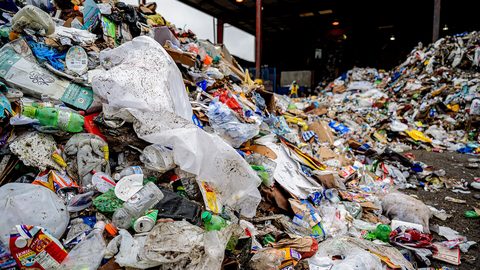
The truck empties its load at a materials recovery facility (MRF) operated by ALBA W&H Smart City under NEA contract, located in Tuas. This is the Singapore MRF sorting process: a sequence of trommels, ballistic separators, optical sorters, magnets, eddy current separators, and manual pickers that separates the commingled stream into individual grades.
Step by Step on the Sorting Line
First, the load passes through a trommel, a rotating drum with holes that screens out small contaminants like broken glass and grit. Next, a ballistic separator splits the stream by shape. Flat items (paper, cardboard) go one way; rolling items (bottles, cans) go another. Optical sorters use near-infrared sensors to identify plastics by polymer type and eject them into separate bins with puffs of air. Magnets pull out ferrous metals. Eddy current separators repel non-ferrous metals like aluminium. Manual pickers remove large contaminants and items the machines miss.
The output is a set of sorted recyclables: baled paper, crushed PET bottles, shredded aluminium cans. Each grade is destined for a different end-market. The residue, the fraction no machine or picker could recover, is trucked to a waste-to-energy plant.
The MRF Residual Rate: Where Recycling Actually Fails
The MRF residual rate is the percentage of incoming commingled material that the facility sends to incineration. NEA does not publish this number directly. It is the real loss point. If the domestic recycling rate is 12% (2023 figure, NEA Waste Statistics) and the contamination rate is 40%, roughly half of what goes into the blue bin is sorted out and burned. The official domestic recycling rate counts the entire blue bin collection as recycled because the measurement point is at collection, not at material recovery. The gap between the claimed rate and the real rate is the contamination rate.
Recycling Export Singapore: Where the Recyclate Goes
Recycling export Singapore is the destination for most sorted recyclables. Singapore has no large domestic manufacturing base that pulls recyclate through the system. No paper mills consume recovered fibre at scale. No plastics reprocessors take mixed polymer bales. The sorted material is baled and shipped to overseas end-markets, primarily in Southeast Asia, China, and India. The price those markets pay, and the contamination level they accept, determines whether a bale is sold or rejected. When China tightened its import standards under Operation National Sword in 2018, Singapore's sorted paper and plastics lost their primary buyer. The MRF residual rate rose.
Blue Bin After Collection NEA: The Rejected Stream Goes to Incineration
What the blue bin after collection NEA system does with non-recyclable residue is incinerate it. Singapore operates four waste-to-energy (WTE) plants: TuasOne, Tuas South, Keppel Seghers Tuas, and Senoko. Incineration reduces waste volume by up to 90%. It does not eliminate the residue. The incineration bottom ash (IBA), roughly 15-20% of the original waste mass, and the stabilised fly ash are barged to Semakau Landfill.
Plant Closures and the Tuas Nexus
Senoko Incineration Plant (commissioned 1992) and Tuas South (commissioned 2000) are scheduled for closure as the Integrated Waste Management Facility (IWMF) at Tuas Nexus comes online; the first phase was expected operational from 2025. Tuas Nexus co-locates the IWMF with a NEWater plant, raising energy recovery efficiency by using waste heat to power water treatment.
Sarimbun Recycling Park Process: Where Sorting Actually Happens
While the main MRF for commingled blue-bin recyclables is in Tuas, the Sarimbun Recycling Park process covers a different part of the system. Sarimbun Recycling Park, in Lim Chu Kang, houses private recyclers and specialised facilities that handle streams the blue bin cannot accept: wood waste, construction and demolition debris, horticultural waste. The park functions as an industrial zone for material recovery outside the PWC contract. If a blue bin load is sorted at a Sarimbun MRF rather than the Tuas facility, the difference is in the mix of incoming material and the end-market contracts, not in the fundamental sorting technology.
The Incineration Endpoint: Tuas South and Semakau Landfill
Tuas South Incineration Plant is Singapore's largest WTE plant. It is the most likely destination for MRF residue generated in the western sectors. The IBA leaves the plant and is loaded onto barges for the trip to Semakau Landfill, an engineered enclosure between Pulau Semakau and Pulau Sakeng. Semakau covers 350 hectares, began operating in 1999, and at current waste disposal rates is projected to close around 2035 (MSE Zero Waste Masterplan, 2019). That closure date has been moving. It has been 'about 15 years away' for two decades, because waste generation and ash production rates change each year.
Non-incinerable waste also goes directly to Semakau. The landfill receives only ash and non-incinerable material. No raw household waste is buried there.
Common Questions
What is the MRF residual rate for Singapore's blue bin recycling?
NEA does not publish a single figure, but with a domestic recycling rate of 12% and a contamination rate of 40%, the real recovery rate after sorting is roughly 7%. The rest is incinerated.
Does Singapore export its recycling?
Yes. Sorted recyclables, paper, plastics, metals, are baled and shipped to end-markets in Southeast Asia, China, and India. Singapore has no large-scale domestic reprocessing capacity for these materials.
What happens to contaminated items in the blue bin?
They are sorted out at the MRF and sent to a waste-to-energy plant for incineration. The ash from that incineration is barged to Semakau Landfill.
Why is the domestic recycling rate so low in Singapore?
The 2023 rate was 12% because 40% of blue bin contents are contaminated. The measurement point is at collection, not after sorting, so the published figure overstates what is actually recycled.