How Construction and Demolition Waste Recycling Works in Singapore
Why Singapore's construction and demolition waste recycling rate exceeds 99%, how it shapes the national recycling figure, and what happens to the recovered concrete and metal.
Singapore Reports A 99% Construction And Demolition Waste Recycling Rate. Here Is What That Number Actually Means
Singapore’s National Environment Agency (NEA) reports that 99% of construction and demolition (C&D) waste was recycled in 2023. That figure, 1,439,000 tonnes recovered out of 1,444,000 tonnes generated, makes C&D recovery the single largest contributor to the national recycling rate. It is also the main reason that headline number (52% in 2023) is misleading when applied to households. The C&D rate is not a measure of household behaviour. It reflects the recovery of inert substances: crushed stone, scrap metal, bricks, timber, and asphalt from demolition and construction sites. Private-sector recyclers process these streams. They never enter the municipal incineration system. The residual that was not recovered went to incineration; the resulting ash went to Semakau Landfill.


Why The C&D Waste Recycling Rate Is So High: The Inert Advantage
The C&D stream is dominated by concrete, bricks, and metals. Those substances are heavy, chemically stable, and valuable as feedstock for secondary markets. Concrete is crushed into recycled aggregate for road base and backfill. Scrap metal is melted down at local smelters or exported for steel production. Timber waste is chipped for biomass fuel or engineered-wood products. Asphalt is milled and reused in new road surfacing. None of these processes require the complex sorting or contamination control that household recycling demands.
The regulatory framework enforces this outcome. Under the Building Control (Environmental Sustainability) Regulations 2008, any project with a gross floor area of 5,000 m² or more must submit a waste management plan and sort concrete, bricks, metals, wood, and horticultural waste on-site for recycling. The Building and Construction Authority’s Code of Practice on Buildability makes the segregation a mandatory condition of approval. There is no C&D waste levy or landfill tax. The economics rely on the value of recovered feedstock and the cost of disposal. That tiny residual tonnage means the system is efficient enough that almost nothing reaches the incinerator.
C&D Waste Singapore Rate: 99% Year After Year, But The Peak Has Passed
The C&D recovery rate has held between 98% and 100% every year from 2014 through 2023. That consistency is not a sign of improvement. It is a ceiling. The rate cannot exceed 100%, and the actual tonnage recovered depends entirely on construction activity. The peak generation year was 2016, when 1,849,000 tonnes of C&D waste were produced. By 2023, that had fallen to 1,444,000 tonnes, a 22% decline that mirrors the slowdown in building projects. The recycling rate stayed above 99% through both the peak and the drop.
The real story is not the rate but the volume. When construction activity rises, so does the tonnage entering the recovery chain. When it falls, the system has spare capacity. The landfill diversion benefit is stable across both scenarios because the residual waste that does escape recycling is a tiny fraction of the total. That residual is sent to incineration, and from there to Semakau, but it accounts for less than 0.4% of the stream.
| Metric | Value |
|---|---|
| Total C&D waste generated | 1,444,000 tonnes |
| Total C&D waste recycled | 1,439,000 tonnes |
| Recycling rate | 99% |
| C&D waste disposed (incinerated) | 5,000 tonnes |
| C&D waste as share of total waste generated | 21% |
| C&D waste as share of total waste recycled | 55% |
| Peak generation year (2016) | 1,849,000 tonnes |
| Rate range 2014–2023 | 98% to 100% |
Demolition Waste Disposal Singapore: Where The Material Goes And Who Handles It
Demolition waste disposal follows a three-step route: on-site sorting, off-site processing at dedicated recovery facilities, and sale of reclaimed feedstock to end users. The on-site sorting is mandatory for large projects, but even smaller sites segregate because the loads have value. Mixed deliveries that arrive at sorting facilities are processed through crushers, shredders, magnets, and screens. Crushed aggregate is the highest-volume output; scrap metal is the highest-value.
Sarimbun Recycling Park And Private Recyclers
Much of this processing happens at Sarimbun Recycling Park in Lim Chu Kang, an industrial zone housing recovery facilities and recyclers. Private-sector companies run these plants. They compete for feedstock from demolition contractors, which keeps recovery rates high. The BCA’s Code of Practice on Buildability reinforces this by requiring waste management plans that name the recycling destinations.
Semakau Construction Waste: Only The Non-Recyclable Residue Reaches The Landfill
Semakau Landfill receives ash from incineration, not C&D waste directly. The residual C&D tonnage that was not recovered in 2023 went to an incineration plant first, Tuas South, Senoko, or Keppel Seghers Tuas, and the resulting incineration bottom ash was barged to Semakau. That means the physical volume reaching the landfill from the C&D stream is roughly 15-20% of the original residual tonnage, or about a thousand tonnes of ash. For context, Semakau had approximately 16 million m³ of remaining capacity in 2023, and its projected closure date at then-current disposal rates was 2035. The C&D stream’s contribution to that fill rate is negligible.
NEA Construction Waste Rules: What Developers And Contractors Must Do
The construction waste rules are not a separate regulation. They are embedded in the Building Control (Environmental Sustainability) Regulations 2008, enforced by the Building and Construction Authority (BCA). The rule that drives the 99% recovery rate is the mandatory waste management plan for projects with a gross floor area of 5,000 m² or more. That plan must specify how concrete, bricks, metals, wood, and horticultural waste will be sorted on-site and sent to recyclers. The BCA approves the plan before construction begins and audits compliance during and after the project.
The rule is enforced through the building permit process. A project that cannot show a recycling route for its C&D waste does not get approval to build. That gives the system a hard enforcement point that household recycling lacks. There is no equivalent gate for the blue bin: contamination rates above 40% have no consequence for the householder. The C&D stream succeeds because the regulation applies at the point of generation, not at the point of disposal.
What The Rules Do Not Cover
The regulations do not apply to renovation waste from individual homes or small commercial fit-outs. Those loads are collected by general waste collectors and sent to incineration. The tonnage from small-scale renovation is small relative to the 1.4 million tonnes of large-project C&D waste, but no separate figure is published. If you are renovating a flat, the contractor’s disposal route is your responsibility. Ask for a recycling certificate before you pay the final invoice.
Also in Waste streams
Common Questions
Is the 99% C&D recycling rate real, or does it count incineration as recycling?
It is real. The 99% rate counts only material that is actually recovered and sent to a recycler. Incineration is not counted as recycling. The residual tonnage that was not recovered went to incineration, and that tonnage is excluded from the recycled figure.
Does the 99% rate apply to all demolition waste, including hazardous materials?
No. The C&D waste statistics cover inert and non-hazardous materials. Asbestos, chemical containers, and other hazardous demolition waste are handled under separate hazardous-waste regulations and are not part of the C&D recycling rate.
Why is C&D waste such a large share of total waste recycled in Singapore?
C&D waste made up 55% of all waste recycled in 2023, despite being only 21% of total waste generated. The reason is that the stream is dominated by heavy, high-value materials (concrete, metal) that are easy to recycle, while the largest waste stream, domestic waste, has a recycling rate below 15%.
What happens to recycled concrete aggregate in Singapore?
Crushed concrete is used as road base, backfill, and drainage material in construction projects. The Building and Construction Authority encourages its use through the Sustainable Construction framework. It replaces virgin granite and reduces the need for imported aggregate.
Does Singapore have a landfill tax or levy on C&D waste?
No. There is no C&D waste levy or landfill tax. The system relies on regulation (mandatory waste management plans and on-site sorting) and the market value of recovered materials. The absence of a tax means the financial incentive to recycle comes from avoiding incineration and disposal costs, not from a penalty.
How does Singapore's C&D waste recycling rate compare to other countries?
Singapore’s rate is among the highest reported globally. The European Union’s target for C&D waste recycling is 70% by 2020 (revised in some member states). Japan reports rates around 97-98% for concrete and asphalt. Hong Kong’s rate is roughly 90% for inert material. Singapore’s 99% is possible because of the regulatory mandate, the high value of scrap metal, and the small volume of residual waste that cannot be recycled.
Will the C&D recycling rate decline if construction activity drops?
The rate will stay above 98% regardless of activity level. The recycling infrastructure is built and paid for. The risk is not a drop in the rate but a drop in the tonnage recycled, which reduces the contribution to the national recycling rate. That would make the headline national number even more dependent on industrial streams, widening the gap between the national and domestic recycling rates.
Read next
-
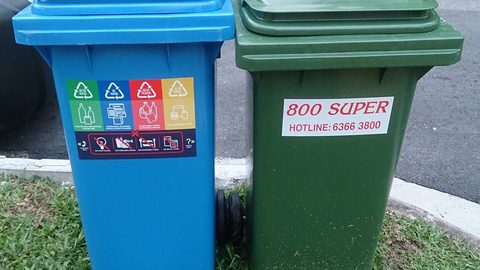 What the Blue Bin Actually Takes and What Happens When It Gets Contaminated
What Singapore's blue bin actually takes—and what happens to a whole truckload when one item is wrong. The contamination rule, not just the list.
What the Blue Bin Actually Takes and What Happens When It Gets Contaminated
What Singapore's blue bin actually takes—and what happens to a whole truckload when one item is wrong. The contamination rule, not just the list.
-
 What Must Never Go in a Singapore Household Bin and Where It Goes Instead
Batteries, lamps, chemicals and sharps must never go in a Singapore household bin. Where each goes instead, scoped to Singapore disposal law.
What Must Never Go in a Singapore Household Bin and Where It Goes Instead
Batteries, lamps, chemicals and sharps must never go in a Singapore household bin. Where each goes instead, scoped to Singapore disposal law.
-
 E-waste
Singapore's e-waste Producer Responsibility Scheme makes producers fund collection and recycling. Small tonnage, high value, and a genuine battery fire risk.
E-waste
Singapore's e-waste Producer Responsibility Scheme makes producers fund collection and recycling. Small tonnage, high value, and a genuine battery fire risk.
-
 Bulky waste in Singapore
What happens to bulky waste in Singapore after the town council collects it, from dismantling and metal recovery to incineration at Tuas South and the ash that reaches Semakau Landfill.
Bulky waste in Singapore
What happens to bulky waste in Singapore after the town council collects it, from dismantling and metal recovery to incineration at Tuas South and the ash that reaches Semakau Landfill.
-
 Plastic
Resin codes are not a recyclability rating. In Singapore's blue bin system, a plastic item is recycled only if it survives the MRF sort and finds a buyer.
Plastic
Resin codes are not a recyclability rating. In Singapore's blue bin system, a plastic item is recycled only if it survives the MRF sort and finds a buyer.
-
 Household batteries
Why household batteries cause fires in Singapore's waste system and the correct disposal pathway through ALBA E-waste collection points under the Producer Responsibility Scheme.
Household batteries
Why household batteries cause fires in Singapore's waste system and the correct disposal pathway through ALBA E-waste collection points under the Producer Responsibility Scheme.
-
 Food waste
 is Singapore's heaviest household stream and the hardest to recover. Moisture and decomposition make it a problem before sorting even begins.
Food waste
Food waste is Singapore's heaviest household stream and the hardest to recover. Moisture and decomposition make it a problem before sorting even begins.
-
 Glass
Glass is infinitely recyclable in theory but breaks in Singapore's commingled blue bin and contaminates paper. Ceramics are the specific poison.
Glass
Glass is infinitely recyclable in theory but breaks in Singapore's commingled blue bin and contaminates paper. Ceramics are the specific poison.